Canada
August 31, 2005
China leads the charge as Asia takes top position in the new
world order of beer production. A look at four key trends and
what they mean for the future.
Big changes
are brewing on the international beer production scene. While
Canada and most other industrialized nations are declining in
production, Asia is more than making up for that deficit - with
double digit growth that is propelling a steady rise in world
beer production.
What does
this mean for Canada in the world malting barley trade? Rob
McCaig of the Canadian Malting
Barley Technical Centre (CMBTC) broke down the changes in a
presentation at the 2005 North American Barley Researchers
Workshop (NABRW) in Red Deer, Alta.
Following the
session, he spoke with
Land and Science about four key trends. Here are
highlights of the conversation:
1. China
fuels Asian rocket
Asia is the
new global king of beer production, and China is leading the
way. The monolithic country produces 64 percent of the beer
produced in Asia and has experienced double-digit growth in this
production for the past five years.
"There is a
tremendous amount of change taking place in the brewing
industry," says McCaig. "Most of the industrialized nations,
including Canada, have been declining in production, but the
slack is being taken up by Asia and South America."
Overall,
world beer production is growing at a steady pace, he says, from
1.21 billion hectolitres in 1994 to 1.48 in 2003. Along with
China, other notable countries for production growth include
Vietnam, India, Mexico, Columbia and Russia.
2.
Consumption on the rise
Spurring the
global rise in beer production is a similar rise in consumption.
World beer consumption has increased steadily from 116 billion
litres in 1993 to 150 billion litres in 2005. Among countries,
long-time leader the U.S. remains the top consumer, with 23.82
billion litres consumed in 2002. But China is hot on its heals
with a dramatic rise to 23.49 billion litres consumed that same
year.
"On a per
capita basis, beer consumption in China has gone up quite a bit,
but is still relatively low," notes McCaig. "The driving force
behind China's rising consumption has been its increasing
population."
|
 |
|
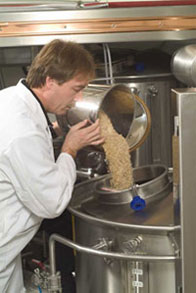
McCaig tests new malting barley varieties at CMBTC in
Winnipeg |
3.
Emergence of 'supercompanies'
Another
hallmark of beer production today is massive consolidation among
brewers, says McCaig. Today, the top four brewers - Interbrew,
SABMiller, Anheuser-Busch and Heinekin - produce approximately
30 percent of the world's beer, and that percentage is rising as
the big brewers continue to merge and buy up smaller brewers.
"The brewing
world continues in a major consolidation phase, where bigger is
better - it's more economical and its essential to maintain
strong global brands," says McCaig. "In the future, we see the
number of large brewers shrinking still further into a handful
of supercompanies."
The malting
production sector is also going through broad consolidation.
4.
Canada's opportunity
As for what
these big picture shifts mean for Canada in the malting barley
trade, McCaig says everything points to strong opportunity.
"Beer
production is a market that recognizes quality in barley, and
Canada has a strong reputation for producing high quality
malting barley," he says. "The world malting barley trade has
risen from just under 5,000 million tonnes in 2000, to over
5,600 MT today, and it's expected to further increase to around
6,400 MT by 2011. There is solid potential in those growing
numbers for Canada to improve its opportunity for generating
higher returns for its barley crop"
© 2005
Meristem Information Resources Ltd. |


