Canada
November 29, 2005
Reprinted with permission from
Meristem Land and Science,
www.meristem.com
Without action now
to strengthen crop development research, Canada risks losing
major ground in agriculture, says the veteran barley breeder.
It just doesn't make business
sense.
 |
|
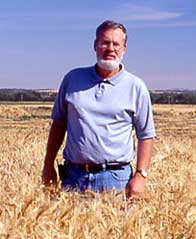
Dr. Jim Helm's message on grains
research is simple: "Support it or lose it" |
Canada has built a network of
crop development research programs that play a critical role in
the country's agriculture and food industry. They provide
returns in the form of new crop varieties and knowledge that are
proven to deliver strong and reliable investment value. In fact,
crop development research is viewed by several agricultural
economists as providing among the best investment returns of any
area of agricultural research over the past 20 years.
Yet Canada's major crop
development research programs for traditional grain crops - such
as wheat, barley and oats - are in danger of being woefully
under-funded compared to similar programs supported by Canada's
competitors.
'Waking up' to a critical
resource
Canada's programs for these
crops have traditionally been supported by public funding, and
over the past decade grain producers have stepped up and
provided support through check-offs. Royalties on seed sales
have also played a small but significant role. But public
funding has been steadily reduced for these programs over the
past 10-15 years and there's danger of further reduction.
Governments are re-prioritizing
research investment and directing more dollars away from crop
development research toward efforts seen as more novel, further
up the value chain, or providing quick payoff (developing a new
grain variety can take from six to 12 years). At the same time,
industry sectors that have long benefited greatly from
development research for these crops, such as the livestock
industry, the malting and brewing industry and the food
industry, have provided little, if any, investment support.
Because the vast majority of
grain farmers use farm-saved seed and only purchase Certified
seed every three or four years, there has been little economic
incentive for private breeding programs or seed company
investment in existing programs.
 |
|
Helm discusses barley research
progress during a Field Crop Development Centre plot
tour. |
For veteran crop development
scientists such as Dr. Jim Helm, who has helped lead barley
development research in Alberta for three decades, the situation
is understandably frustrating. But for Helm, it's not just about
keeping his program or those of his colleagues strong and
sustainable, it's about Canada and its agriculture and food
industry needlessly weakening a proven, powerful resource. As a
result, Canada risks losing major competitive ground and
opportunity.
A big problem is getting people
to wake up to the critical role and importance of crop
development research, he says. Traditional crops such as grains
tend to be taken for granted, but to remain viable they depend
on crop development research just as much as any other crop.
When you consider these crops continue to dominate production,
fuel several multi-billion dollar industries and are a critical
foundation to the emerging revolution in bio-potential, it's not
hard to see what's at stake if this research goes under-funded.
"We have built a strong
research base, and we need to keep this in tact in order to
capitalize on where we need to go in the future," says Helm,
head of research at the Field Crop Development Centre in
Lacombe. "We're not doing that.
"As researchers in this area,
we're fighting a battle across Canada on how important crop
development research is. Collectively, crop development research
is at a crossroads and there's potential to lose what we've
built if we don't act decisively."
Anchor to multi-billion dollar
sectors
Canada delivers over $24
billion worth of agriculture and food products to more than 180
countries around the world every year.
Three big drivers of that are
wheat production, barley production and livestock production,
which account for a large portion of that total. Livestock
production counts on barley and wheat as major feed sources and
all three sectors of production depend heavily on crop
development research to be successful.
"Ask yourself, where would the
cattle industry be without a steady supply of cost-effective,
high quality feed barley?" says Helm. "Without strong crop
development, we won't have varieties farmers want to grow or
that the industry needs to succeed."
Research into newer crops and
applications is what draws attention these days. But traditional
crop breeding has proven itself time and time again to be a
backbone of Canada's success, and one that remains equally if
not more essential for the future.
In wheat, for example, markets
have become more diversified and sophisticated. To keep up,
Canada needs a steady stream of varieties that deliver top-notch
quality for these markets, while providing the yield potential,
resistance to ever-shifting insect and disease pressures, and
other key characteristics that farmers need to produce a
profitable crop. The same requirements are needed for the other
grain crops, for the full range of feed, food and other market
options.
Dramatic new potential
People think of traditional
crops such as wheat and barley as old standbys. But these crops
have shown a growing number of innovative applications for
today's broad range of emerging bio-potential.
In barley development, for
example, the focus is on new feed types that offer sophisticated
tailoring to meet the nutritional needs of livestock, resulting
in higher performing animals that produce less waste. A new
generation of malting barley varieties is being launched, which
reflects widening international preferences and has renewed
demand for Canadian barley to supply top maltsters and brewers.
At the same time, innovative hulless and specialty starch
barleys are being fine-tuned to capitalize on expanding
opportunities in human food, health and industrial markets.
The health front in particular
looks rosy for barley, Helm points out. Researchers have found
the grain contains higher levels of beta-glucan, a type of fibre
linked to reduce levels of blood cholesterol. Barley also
contains several powerful antioxidants, most notably tocophenol,
which is associated with reducing the risk of cancer. These
properties already represent a rapidly growing sector of the
emerging "nutraceuticals" market, a burgeoning market of the
future expected to represent $250 billion by the year 2020.
Stepping up to the plate
The investment value of crop
development research for grains is not a question. One study, by
independent economist Dr. Joseph Nagy, put the return on
investment in Field Crop Development Centre research at a
minimum 10-to-one. Numerous studies have consistently pegged
crop development research for grains as delivering strong
investment value - among the strongest of any research in
agriculture.
The question is why isn't there
more investment in this research.
"In barley development in
Canada, we've seen our budgets generally dropping over the past
10-15 years," says Helm. "That is a big concern for me, and I'm
speaking from the standpoint of the agriculture industry as a
whole. We cannot see this budget drop anymore."
Canada has about the half the
researchers in barley breeding as it did 10 years ago, he
observes. "Right now, we have six barley breeders in Western
Canada for 10-11 million acres of barley. It's unbelievable.
"The U.S. barley production is
now dropping this year below four million acres. Barley is going
to become a specialty crop down there. There's going to be fewer
acres of barley in the U.S. this year, than oats. And Australia
has about half of Canada's acreage. Both those countries are
spending two to three times or more than we are on barley
genetics and all the other related types of research. Meanwhile,
we're having a difficult time here just keeping our basic
programs funded. How do we keep up?"
The need for strong public
funding is a key factor, but Helm is also disappointed in the
lack of support from industry. For his program, which focuses
heavily on feed barley development, a major source of
frustration is the beef industry, which benefits greatly from
strong barley production fueled by strong crop development, yet
largely fails to recognize the value of variety improvements or
significantly support that effort. By contrast, Australia has
benefited from strong cooperation and funding across industry
sectors.
"I don't believe the livestock
industry is stepping up to the plate," says Helm. "They just
want cheap. I think they're afraid to change their approach,
because they're afraid that they're going to have to pay more
for research or more for barley as its true value is recognized.
And I think that's a fear based on bad economics. Barley
development research is an investment that generates higher
returns in the market for everyone involved. If we can develop
systems that benefit both the crop producer and the livestock
producer, everyone wins in the end."
Canada needs strong support for
its crop development research, and that needs to happen soon,
says Helm. Everyone, from the research and investment
decision-makers to the many industry sectors that benefit from
this research, needs to be more aware of the stakes and to do
their part. "It's a simple decision - support it or lose it," he
says. "The time is now to get our crop development system back
on track."
More information on the issue
of crop development research is available in a special Report on
Crop Development,
"The
Elephant in the Room," available on the Meristem Land and
Science Web site, at
www.meristem.com.
Reprinted with permission from
Meristem Land and Science |


