Canada
November, 2006
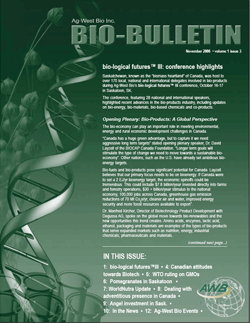 Source:
Ag-West Bio Inc. Bio-Bulletin Volume 1, Issue 3 Source:
Ag-West Bio Inc. Bio-Bulletin Volume 1, Issue 3
Bio-Bulletin in PDF format:
http://www.agwest.sk.ca/publications/Bio-Bulletin/BBNov06.pdf
by Janice Tranberg
Regulatory Affairs Director,
Ag-West Bio Inc.
Adventitious presence has always
been a part of export and trade, but with the influx of new
traits being introduced into crops around the world, this issue
is becoming front and centre. A perfect example can be found in
the currently incidental release of Bayer’s herbicide resistant
rice – LLRICE601.
On August 18, 2006, the United
States Department of Agriculture (USDA) Animal and Plant Health
Inspection Agency (APHIS) announced trace amounts of a
genetically engineered variety of rice had been detected in long
grain rice. Bayer CropScience disclosed full information on this
rice line to the USDA, as well as the Canadian Food Inspection
Agency (CFIA), but each government chose a very different path
to deal with this unapproved event.
The glufosinate tolerance trait in this case involves the same
gene (bar gene) used by Bayer in its other Liberty Link crop
species, and in fact is the same gene used in two other rice
varieties – LLRICE06 and LLRICE62 – both of which are approved
for human consumption in the U.S., with the latter approved for
use in Canada.
There are small variations in
these three lines. Both the approved varieties were transformed
using direct gene transfer, while the variety in question was
transformed using agrobacterium-mediated transfer. Another
difference lies in the promoter used to drive the expression of
the bar gene. The 35SCaM promoter is slightly longer in the
unapproved line as compared to the two approved lines. Finally,
both approved lines were engineered into a medium grain rice
variety, while LLRICE601 was placed into a long grain variety.
The USDA’s regulatory system has
built in some flexibility to deal with these kinds of issues,
which allowed for an extension of the non-regulated status of
this variety based on the previous deregulated LLRICE06 and
LLRICE62 rice lines.
After performing an environmental
assessment, the USDA found no human health, food, feed or
environmental concern with this variety. The analysis of their
assessment concluded both methods of transformation are standard
practices for introducing genetic material into plant genomes,
the size difference of the commonly used 35SCaM promoter is not
significantly different, and the host rice varieties are not
significantly different (Department of Agriculture, Animal and
Plant Inspection Service, Docket No. APHIS-2006-0140, Federal
Register Vol. 71, No. 174, Friday, September 8, 2006).
Therefore, the USDA reached a preliminary decision to extend the
non-regulated status for the rice line LLRICE601 and placed it
open for public comment until October 10, 2006. No final
decision has yet been announced.
Canada, on the other hand, has no
allowance to extend a product registration and so had to take a
different approach. Again, through a preliminary scientific
assessment, the CFIA found LLRICE601 at low levels is unlikely
to pose a risk to human health, food, feed or the environment,
especially as regular rice is not grown in Canada.
In order to be compliant with the Food and Drugs Act along with
the Feeds Act, the CFIA introduced a strategy to detect the
presence of this rice variety in import long grain rice
shipments. This strategy involves audits of importer
documentation indicating their shipments do not contain
LLRICE601 and random testing by the CFIA of rice imports. A
detection threshold of 0.5 percent of the unapproved event has
been set initially, with a re-evaluation of the effectiveness of
this strategy in two months (Canadian Food Inspection Agency,
Technical Update – Genetically Engineered Rice Unintentionally
Released in the U.S., September 29, 2006).
So, by taking a good look at this
incident, it allows for some interesting comparisons. Both
Canada and the U.S. came to the same conclusion on the safety
and environmental aspects involved with this particular rice.
The U.S. approach, though, has been to efficiently deal with
this variety giving it non-regulated status. Therefore at the
end of this procedure, there will be no additional management
required for rice LLRICE601.
Canada, while being very efficient
in their analysis of the unapproved event, will now have to deal
with the on-going cost and time of monitoring shipments and
conducting spot checks.
I find this a very interesting
case because in terms of decisions, this should have been fairly
simple. A very similar variety has already been found safe for
human and animal consumption in Canada, and in terms of the
environment, it is a non-issue as we cannot grow rice here due
to our climate. And yet, our already extremely busy colleagues
at the CFIA will be required to monitor and sample import
shipments, and additional demands will be placed on our
importers to assure their rice shipments are free of this ‘safe’
rice.
If this level of extra management
is being placed on this fairly straight forward event, I wonder
how the CFIA will manage if an unapproved event is detected
which is not so clear cut?
Janice Tranberg
Regulatory Affairs Director,
Ag-West Bio Inc. |


