Oxnard, California
March 6, 2000
Tampico onion growers began shipping in January this year,
marking one of the earliest seasons on record. In this region where earliness pays and margins are tight, growers pay close attention to
innovations, from cultural practices to new seed varieties. This year, even
more so.
Located in the state of Tamaulipas, this fertile region of Mexico's northeast coast fills an important late-winter market window between the
last western storage onions and the first fresh market types harvested in
the Rio Grande Valley. To hit this window, plantings usually start about
September 20, when conditions are about as tough as it gets to germinate
onions.
"One of the things that happens down here is that they [growers] are trying
to get onions up in some of the most difficult conditions for onions - hot,
wet conditions," explained Asgrow plant breeder Rick Jones PhD., during a
field day sponsored by Baxter Seed Company and Asgrow. "Onions will germinate down to 32 degrees (0° C), it just slows them down," he noted.
"But you get under these hot-wet conditions and you get either some kind of
dormancy or mortality; researchers just don't know much about it."
Despite such environmental challenges, the Tampico onion industry is thriving. Acreage is up nearly 30% this season from the average. According
to Asgrow sales representative Mike McLarty, about 9,000 acres were planted
with white onions, destined for Mexico's national market and other areas.
About 7,200 acres of yellows and 1,800 acres of reds were dedicated for
export to the United States. Unfortunately, this year's near-perfect conditions were marred by low market prices, reported growers.
WORDS OF WISDOM
Colorful, opinionated and articulate, grower Lynn Jones is considered an
industry icon by most. Now 79 years old, he helped establish the Tampico
onion deal in the 1950s, when local farmers 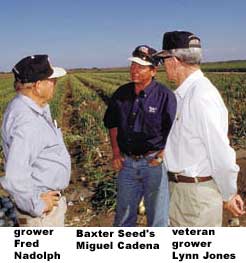 were looking for an alternative
to cotton. He strongly believes that growers must continue to innovate,
whether its new cultural practices like drip irrigation or new seed varieties. Throughout his long career, he has aggressively trialed new
hybrids, always looking for improvements. were looking for an alternative
to cotton. He strongly believes that growers must continue to innovate,
whether its new cultural practices like drip irrigation or new seed varieties. Throughout his long career, he has aggressively trialed new
hybrids, always looking for improvements.
Jones emphasizes the importance of earliness. While growers down here can
manipulate maturity by changing the planting date (more than they can further north in the U.S.), competition among growers often pushes up the
harvest date. "We can't wait until the darn tops go down and turn brown
before we harvest them, you know. Because your neighbor is over there harvesting his. You try to wait, and by then the price has dropped two,
three dollars a bag." For its earliness and good shipping ability he favors
Texas Early White, one of the most widely planted open-pollinated varieties.
But like most of the growers, he's ready for improvement.
"Stand establishment is really a problem in Texas Early White in Tampico,"
agreed Asgrow's Rick Jones. "It's a beautiful product once you finally get
it made, but it costs you more money [on labor] because the early performance is poor." This is especially a problem in Tampico since growers
overplant and hand thin to get a final stand.
"One of the complaints that growers have about Texas Early White is that you
plant it, it comes up, and then you thin it. Then it comes up some more,
and you thin it again, and so on," described Baxter's general manager Michael Key. While labor is relatively inexpensive, tighter profit margins
and low prices this year are making it necessary for growers to look for
savings. He's confident that new hybrids from Asgrow Vegetable Seeds, which
combine early vigor and uniformity with high quality bulbs, may be the
answer they are looking for.
TRIAL RESULTS
Placed in commercial production fields and subjected to the same conditions
as the field variety, a number of new and upcoming Asgrow varieties were
showcased at field days this season - the largest event was held on the La
Palamo Farm of Fred Nadolph, one of Tampico's most respected growers.
 According to reports, Asgrow's
Marquesa has been one of the top yielding white varieties, typically developing a strong root system and vigorous
tops. "Marquesa will jump out of the ground," said Mike McLarty, Asgrow
sales rep. "It's more uniform, and more reliable than many commercial
open-pollinated varieties." According to reports, Asgrow's
Marquesa has been one of the top yielding white varieties, typically developing a strong root system and vigorous
tops. "Marquesa will jump out of the ground," said Mike McLarty, Asgrow
sales rep. "It's more uniform, and more reliable than many commercial
open-pollinated varieties."
"It's a little bit later than Diamante, but it has better disease resistance," observed Jesse Tomás, of George Thomas Farms. He planted
several large blocks of Marquesa this year. It has a good globe shape, few
splits and junks, and good bolt tolerance during cold weather, he reported.
Asgrow has also advanced two white hybrids, XP 6798 and XP 6800, and will be
conducting final performance trials next season.
"I like this size!" Lynn Jones observed, walking down a trial row of XP
6798. "We got to have large-mediums, and when they [buyers] are talking
about large-mediums, they are talking about onions 2 1/2 to 3 1/4 inches in
diameter." He noted that twenty to thirty years ago a medium was 2 to 3
inches, and a jumbo was anything over 3 inches. "Now they want them larger," he said.
"We're getting super-colassals. Five years ago I never heard of a super
colossal," echoed Lee Schill from Baxter's, referring to advances made in
yellow onion varieties in particular. "With the new hybrids available now a
thousand bags to the acre, or better, is now possible."
"The 6800 puts the size on," Dr. Rick Jones pointed out. "It's a little
deeper in shape than XP 6798. And as a hybrid it's got much bigger tops
than Texas Early White." Its shape is just about round at that large-medium
size, which growers like because it fills the bag quicker. According to
Jones, XP 6800 can get a little on the big side for the Mexican market (it
was designed more for the Rio Grande Valley), however its size potential
gives growers more size options. "Growers like something that they can be
flexible with," he said.
Both hybrids also have good white color, and good disease resistance to
support new cultural practices. "Traditionally Tampico farmers grow on a
40-inch bed and then they furrow irrigate," explained McLarty. "But that's
all been changing and they're moving to four rows on wider beds with drip
irrigation."
This means more disease pressure. "We have lots of pink root," said Lynn
Jones. "If I plant anything with pink root susceptibility, it's about this
big around," he said, making a walnut-sized circle with his thumb and index
finger.
"We've got disease resistance on both parental lines, so we have good pink
root resistance," reported Dr. Jones. "From what we've seen so far, they
are very good for seedling vigor and stand establishment, and they have good
strong tops as well."
Asgrow Vegetable Seeds, a Seminis Inc. business, develops and markets over 1000 vegetable variety choices in 108
countries. Worldwide headquarters are based in Saticoy, California.
Company news release
N2566 |
