Oxnard, California
July 25, 2000
A new generation of western melon hybrids developed by
Asgrow Vegetable Seeds offer better end-use quality and, according to field
reports, require fewer inputs. Together with changes in growing and shipping
practices, this industry known for its tight profit margins could achieve
meaningful savings.
According to horticulturists on a recent production field tour organized by
Asgrow, narrow market windows and the need for larger sizes compel growers
to "push" varieties, or apply extra water and fertilizer to speed growth and
maturity, and improve size. Most of the new Asgrow hybrids, in contrast, do
not need to be pushed. While it is difficult to quantify the potential
savings, the results without "pushing" have been extremely positive in the
field.
The top-testing new variety is Magellan, a midseason Mission-type hybrid.
According to veteran grower John Summers of Dresick Farms, water management
on the melon was very good, and it still produced mostly 12 sizes; overall
yield was higher than last season. Other major operators had similar success with Magellan.
"This year we have quite a bit of Magellan; it shows promising potential,"
said Jimmy Byrd, ranch manager for Martori Farms in Aguila, Arizona. "The
Magellan is ropier netted [than Mission], which is what the retailers prefer," described Byrd, holding up a large, ripe melon with thick raised
netting. "You put Magellan and Caravelle side by side, and you cannot tell
the difference [between the fruit]." Caravelle is considered by many in the
industry as the benchmark for fruit quality.
One of the important differences that Martori Farms has seen in several
locations is that Magellan has a better vine than Caravelle. "If you pull up
a runner on a Magellan and you pull up a runner on a Caravelle... what
you'll notice is that nodes from where the leaves put off are much closer in
a Magellan than they are in a Caravelle. So you end up with more leaf surface," Byrd noted. This protects the fruit from sun damage, a
grade-reducing defect.
Because of its resistance to Fusarium wilt (race 2), a common plant disease,
Magellan tends to produce a better vine than Caravelle, agreed Asgrow product development specialist Meir Peretz, a former melon grower. "It's
also not a fast as Caravelle, so it gives you a little bit more flexibility
and efficiency in the harvest," he added.
HYBRIDS ON THE HORIZON
Each season, most growers share a portion of their fields with seed
companies like Asgrow to test new hybrids in small plots side-by-side with
their full-scale production hybrids. Many times, it is the growers themselves that are the first to see the promise of a new hybrid.
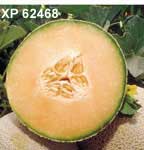 "These two are beautiful melons," said Del Monte harvest manager Gilbert
Coelho, who helped identify Asgrow's most promising new hybrids, XP 6328 and
XP 62468. You can always tell an Asgrow melon by its [deep orange] color and
small cavity," he told a group of Asgrow horticulturists and Del Monte
salesmen. He noted that XP 62468 has a Mission-type net and a shape like
Caravelle. "These are the melons that we like to pack. They look good and
they fit in the box nice." He also liked the stronger-looking vine. "These two are beautiful melons," said Del Monte harvest manager Gilbert
Coelho, who helped identify Asgrow's most promising new hybrids, XP 6328 and
XP 62468. You can always tell an Asgrow melon by its [deep orange] color and
small cavity," he told a group of Asgrow horticulturists and Del Monte
salesmen. He noted that XP 62468 has a Mission-type net and a shape like
Caravelle. "These are the melons that we like to pack. They look good and
they fit in the box nice." He also liked the stronger-looking vine.
"We're getting fantastic reports from a lot of different areas about XP
62468. And that's what you want to see with a variety," said Asgrow plant
breeder Brian Moraghan PhD. "It performs well in Arizona, Central America;
it's always looked fantastic here in the [Central] Valley."
Jimmy Byrd thinks that XP 62468 will have a play next to Magellan, since it
matures 2-3 days later in Arizona. Martori Farms' new variety trial was
located in a Caravelle field, and XP 62468 was half a size bigger than
Caravelle. The Brix was around 13 and it showed very good flesh color, he
reported. "It looks like XP 62468 can be used to complement Magellan where
needed," agreed Jerry Semone, Asgrow sales rep in Fresno, Calif. "It has
unique advantages in areas where papaya ring spot virus is a problem." In
the plots that he evaluated, he found that the cavity of XP 62468 was very
small and Brix in the 13-14 range with no soft fruit.
XP 6328, a rounder Mission-type melon, has received similar accolades. At
Dresick Farms, John Summers noted that XP 6328 produced sizes in the 12
range with small cavities and an average 11-12 Brix. The fruit set was very
heavy, showing high yield potential. Frank Mejia, who is responsible for
growing and operations for Del Monte, reported that XP 6328 produced a
strong plant with heavy set; fruit were round and well netted. Brix was at
11-12 and sizes were mostly 12. In comparison, a widely planted competitor
variety in the same field was half a size smaller with a large open cavity,
he noted.
While this year's new hybrids raise the bar on quality and performance, the
industry doesn't stand still. Today's latest wonder soon fades and growers
and produce buyers looks for something better. For plant breeders, it means
never resting on your laurels. "The melon industry is changing as more
shippers become year-round suppliers," described Moraghan. "Our goal at
Asgrow is to have the perfect melon for every harvest slot and region. It's
a never-ending process of building on your best hybrids and making them
better."
Asgrow Vegetable Seeds, a Seminis Inc. business [NASDAQ: SMNS], develops and
markets over 1000 vegetable variety choices in 108 countries. Worldwide
headquarters are based in Oxnard, California.

Frank Mejia (left)of Del Monte leads of tour of Asgrow horticulturists
through the company's forced-air cooling rooms at its new distribution
center near Phoenix, Arizona. It takes about 5 hrs to cool a load down to
40°F during the heat of summer. |

Asgrow product development specialist Meir Peretz (right) offers samples of
new hybrids to a group of Del Monte salesmen. |
Company news release
N2865 |
