


|
Unlocking the potential of barley breeding: how the HvST1 gene can increase genetic diversity
United Kingdom
HvST1 (which stands for “Sticky Telomeres 1”) is a gene that influences how chromosomes behave during meiosis, the stage of reproduction where genetic recombination happens. Researchers discovered that HvST1 affects how tightly chromosomes stay connected at certain points. By altering this gene, scientists found they could ‘loosen up’ these connections, allowing more gene combinations to emerge during reproduction. The Hutton is home to the International Barley Hub (IBH), a centre of excellence, funded as part of a £62m investment through the Tay Cities Region Deal (TRCD), a partnership between local, Scottish and UK governments and the private, academic and voluntary sectors that reinforces Scotland’s position as a global leader in crop science and climate adaptation. It promotes barley science and collaboration across the scientific, industrial and commercial sectors, with the goal of generating new discoveries and translating them into real-world solutions, safeguarding barley for food, drink and feed markets worldwide. Dr Isabelle Colas, plant molecular geneticist and deputy director of the International Barley Hub (IBH) explained more about these findings: “Barley is one of the world’s most important crops, used in everything from food and animal feed to beer production. At the IBH we are constantly driving innovation to keep this vital crop resilient and sustainable.
“Genetic recombination is the natural process that mixes up DNA during sexual reproduction, creating new gene combinations that can give rise to new traits. For breeders, this genetic reshuffling is crucial in achieving desirable traits in crops. However, in barley, recombination is limited to certain regions of the chromosomes. This ‘recombination bias’ means that only a portion of barley’s genome actively participates in the reshuffling, making it difficult to separate good traits from undesirable ones. Our recent discoveries about HvST1 may help break down this barrier, providing breeders with more flexibility and helping in their search for ideal trait combinations.” Studying a group of barley plants with natural variations in this gene, scientists found that barley plants with a mutated version of HvST1 had increased recombination across more regions of their chromosomes, rather than just in the same limited areas. The change was significant enough to open up whole new sections of the genome for reshuffling, giving breeders access to traits that were previously hard to separate.
The study is published in New Phytologist.
More solutions from: James Hutton Institute Website: http://www.hutton.ac.uk Published: January 22, 2026 |
|
|||||
|
|


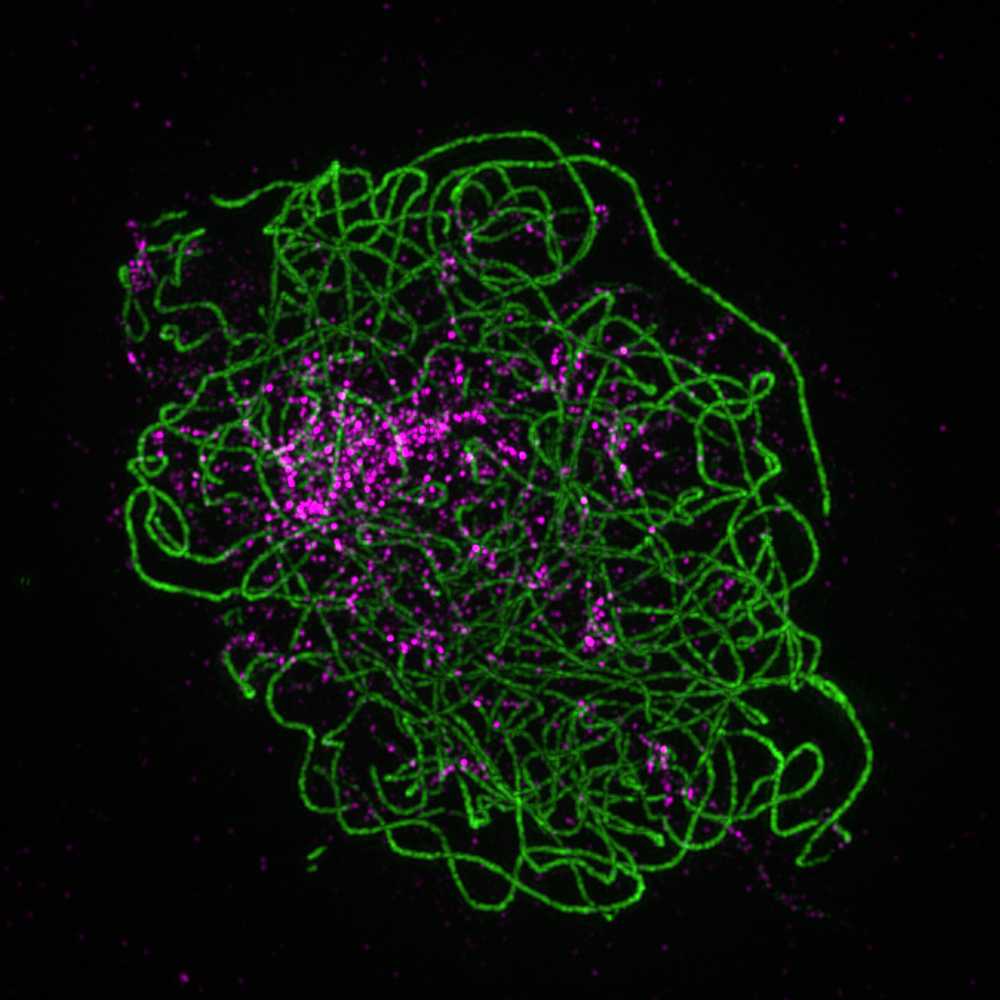 HvST1 cell during meiosis