|
Return on investment for Clearfield rice varieties… Good for you and good for the industry
USA
January 18, 2018

It is well known that the Mid-South rice industry has lost export markets due to poor-quality rice. Foreign buyers state that their dislike for hybrid rice is due not only to milling issues but also chalk content and cooking quality. Horizon Ag offers varieties that fit domestic and foreign end-user specifications. So how can you capture increased ROI for these varieties?
Optimize Yields
Every acre and environment is different, and there’s not a “one size fits all” variety or hybrid. One of the first decisions is to determine which acres in a farming operation need Clearfield® technology. The Clearfield system is still one of the most effective and least costly weed control programs. The next decision is where to plant Clearfield varieties and hybrids to optimize returns. University and Horizon Ag research shows that Clearfield varieties perform best when planted early, whereas Clearfield hybrids fare better planted a couple of weeks into the planting season. By utilizing planting dates, soil types and management strategies, yield can be optimized across all varieties and hybrids.
Optimize Returns – Growing Quality Bushels
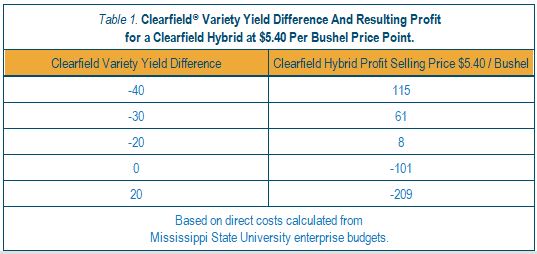
Based on Mississippi State University enterprise budgets, there is an approximately $101 per acre higher direct cost associated with Clearfield hybrids than Clearfield varieties. Not figuring in milling premiums, it takes a 19 bushel per acre yield difference between Clearfield varieties and Clearfield hybrids to break even at a selling price of $5.40 per bushel. Three-year university data shows an average yield difference of 22 bushels per acre between CLXL745 and CL153; however, this yield spread is less when Clearfield varieties are planted early and on easier-to-manage fields. Many growers have attested to a smaller yield spread than this on their individual farms. Table 1 shows the Clearfield hybrid profit/loss compared to Clearfield varieties.
The spread widens when milling discounts/premiums of $0.02/$0.04 per bushel for head/total are applied, based on the 55/70 milling standard. Milling data from university trials averaged over two years shows the average milling yield of CLXL745 was 48/70 and CL153 was 61/71. Table 2 shows the yield difference needed between these two varieties when the discounts and premiums are applied. For example, when the milling difference is considered, for 160 Bu CL153 yield, it takes 190 Bu CLXL745 to break even. When CL153 yields 180 Bu and CLXL745 yields 200 Bu, there is a loss of $61 per acre with CLXL745.
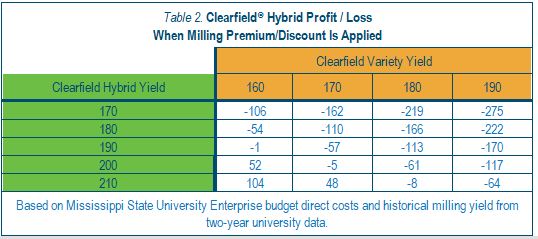
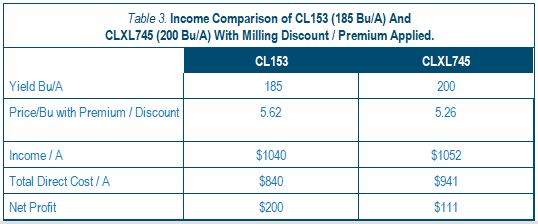
Table 3 demonstrates the following scenario: CL153 had an average field yield of 185 Bu/A with a milling of 61/71, and CLXL745 yielded 200 Bu/A with a milling of 48/71. CL153 has $89/A more net income over CLXL745.
Identity Preservation
When growing high-quality rice, it pays to identity preserve. Even if you are not trying to sell to export markets, domestically it is easier to capture premiums when you separate varieties from hybrids. Milling yields and chalk for varieties are much more consistent and become more valuable as buyers need high-quality rice to blend with lower-quality rice.
More news from: Horizon Ag LLC
Website: http://www.horizonseed.com Published: January 18, 2018 |
|
The news item on this page is copyright by the organization where it originated
Fair use notice |




 Topics
 Species