Grieskirchen, Austria
June 10, 2011
When choosing seed drill technology, factors such as ecology (e.g. protection of the ground) and economy play an increasing role. In addition, very dry drilling conditions like in spring this year make precise seed placement especially important. These demands can be met by using mulch drilling as an alternative to conventional tillage. Pöttinger has investigated ground protection in detail and offers a customized solution with the latest TERRASEM technology.
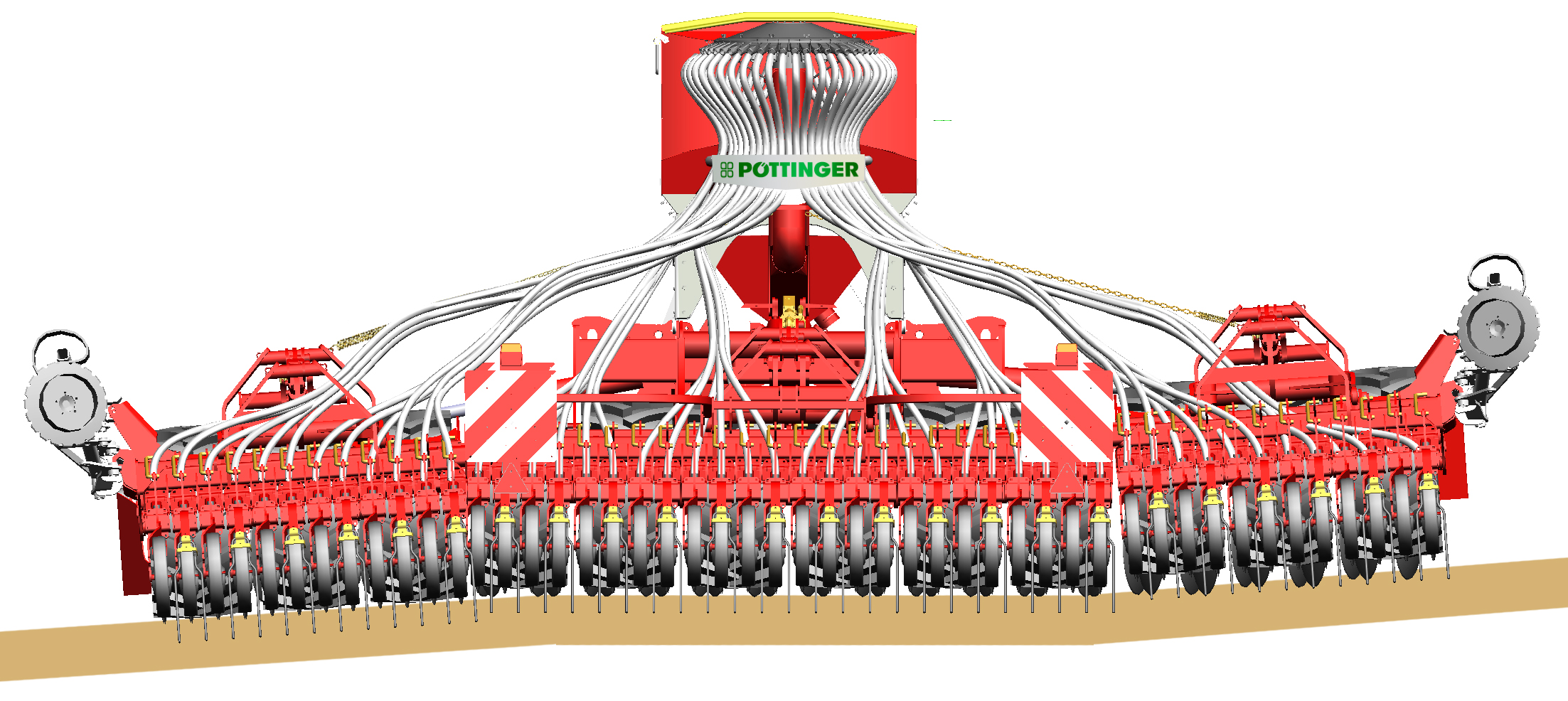
TERRASEM with huge downward flexibility
The packer follows each contour of the ground. This guides the side frames and seed drill over undulations in the ground. The range of adaptation is unlimited upwards and up to 5 degrees of negative movement downwards, maintaining a constant work pressure all the time. The side elements are preloaded using nitrogen accumulators to provide equal pressure distribution over the whole working width. At the same time the leading disc tools are guided over ground contours by the trailed packer roller. The benefits are clear to see:
• precision adjustment of working depth
• no working out of damp earth guarantees homogenous seedbed
• uniform working in of residues
• power peaks are avoided for smooth and continuous operation in the field
On firm ground with packer chassis
The special feature of the TERRASEM is its compact, manoeuvrable construction combined with its unique packer tyre system. The packer wheels are mounted on individual bearings and enable an extremely tight turning radius in the field. Despite the different speeds between the inner and outer wheels on corners, the soil remains level and there is no smearing. At the same time, all wheels are in contact with the ground at the headland.
Drill technology for the highest yields
Soil protection is the basic principle of sustainable agriculture – ensuring high yield and maintaining profit. Pöttinger has designed the TERRASEM concept as a precision seed drill process that protects the ground, ensures fertility and yield, and at the same time reduces costs for the farmer by reducing the tillage requirement.




 Species