November 17, 2025
The recent IITA–CGIAR Knowledge Café seminar, held on 4 November, was an insightful session. The session featured Professor Brian Diers, a leading soybean geneticist and Professor Emeritus at the University of Illinois, who shared practical insights on “Lessons to improve African breeding success” by leveraging lessons learned from the United States soybean-breeding context.
Introducing the guest speaker, Dr Abush Abebe, IITA Soybean Breeder, who described Professor Diers as a plant-breeding researcher, teacher, and former Chair of Soybean Genetics and Breeding at Charles Adlai Ewing Endowed. He noted Professor Diers’ outstanding contribution through the Soybean Innovation Lab (SIL), a USAID-funded project that strengthened soybean research and the soybean industry in Africa.
Drawing from the United States soybean improvement story, Professor Diers illustrated how the country achieved remarkable yield gains over the past century. Despite limited expansion in land area since the 1980s, soybean production has doubled, largely due to private industry investments, good agronomic practices, favorable weather conditions, and genetic improvement breeding, rather than acreage increase. U.S. soybean yields have risen steadily at about 25 to 40 kilograms per hectare per year, demonstrating that sustained investment, strong data management, and attention to breeding fundamentals can drive long-term progress.
While acknowledging the value of advanced tools such as molecular markers and genomic selection, he cautioned breeders against chasing every new “technological fad” at the expense of traditional breeding efficiency. “Funders love high-tech work,” he noted, “but we must remember that technology should complement—not replace—the basics of good breeding.”
The lively question and answer session featured engaging contributions from IITA scientists, including Dr Melaku Gedil, Dr Gaby Mbanjo, Dr Wende Mengesha, Dr Tahirou Abdoulaye, and Dr Hapson Mushoriwa, among others, who raised questions on trait prioritization, genetic diversity, and trade-offs between yield and protein content. Professor Diers encouraged breeders to focus on the most important farmer-driven traits, apply index selection where necessary, and maintain a balance between short-term genetic gain and long-term diversity.
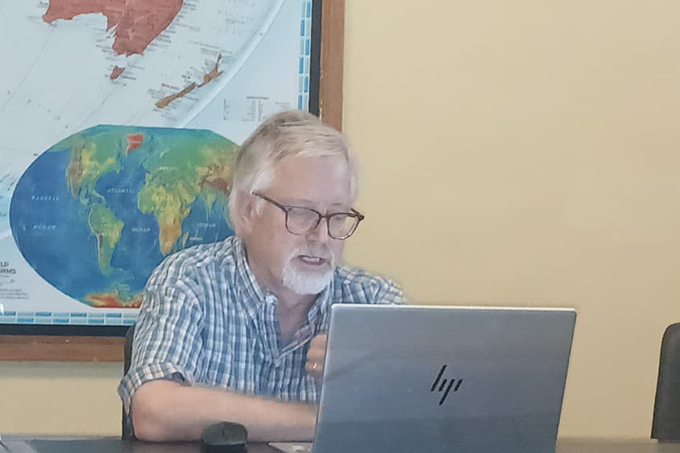 Professor Brian Diers speaking on lessons that can help improve African soybean breeding success
In her closing remarks, Folake Oduntan of the IITA Communication Office, who moderated the session alongside Dr Abush Abebe, thanked Professor Diers and all participants, affirming IITA’s commitment to fostering knowledge exchange. “Let’s keep peddling and doing our best to improve food systems across the globe,” she said.
The Knowledge Café remains a vital platform for sharing expertise and inspiring innovation within IITA and beyond.




 Topics
 Species