Australia
April 23, 2026
Babyleaf spinach is now a consistent part of the market, with demand across retail and food service year-round. For growers, that means delivering reliable supply in a crop that can be sensitive to seasonal pressure. Behind that consistency is ongoing work between breeders and growers — refining varieties to perform across Australian conditions, with a focus on disease resistance, climate resilience and suitability for different production systems, including hydroponics.
Scale and production
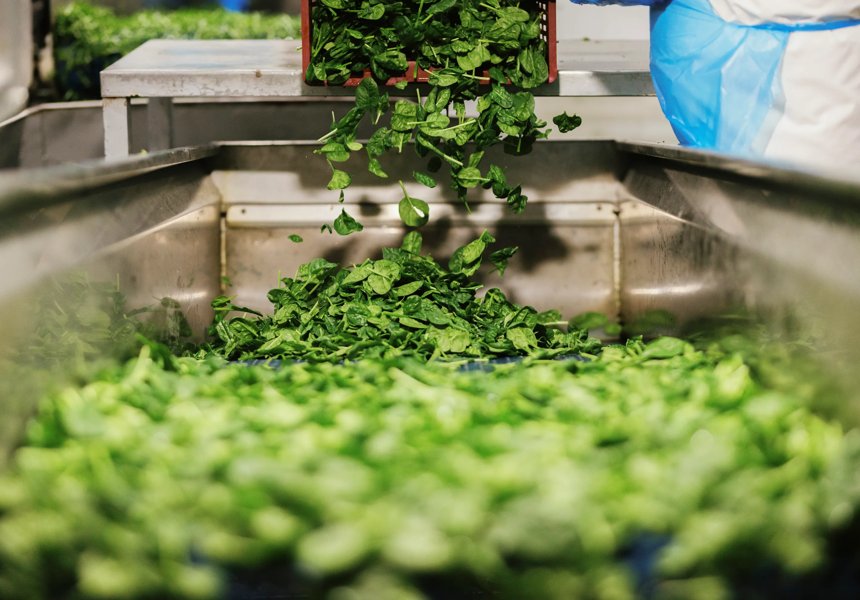
Babyleaf spinach is a fast-turn crop, typically harvested between three and thirteen weeks. Crops are mechanically harvested, then washed and packed for market.
Production operates at scale globally — with spinach farms spanning hundreds of hectares. Growers use multiple regions to maintain supply across seasons. As Wim in ’t Groen, Crop Co-ordinator at Rijk Zwaan explains: “Some growers in northern Europe also own fields in southern Europe, and some Californian growers have locations in Yuma, Arizona. This enables them to supply their customers with fresh spinach all year round,”
Year-round planning, together
Delivering year-round supply relies on careful variety planning. With a broad babyleaf spinach range, growers can select varieties suited to different seasons, growth speeds and disease pressures.
“We offer varieties across a wide range of markets and climate zones — from fast to slower-growing types, with the right resistances where it’s needed,” says Wim in ’t Groen. From a global range of around 75 varieties, key genetics are selected for Australian growers to suit local conditions and production systems.
Choosing the right mix isn’t always straightforward. That’s where local crop specialists and representatives work alongside growers — building programmes that align variety selection with seasonal conditions, disease risk and market requirements.
Breeding beyond today
Breeding is about staying ahead of what’s coming next. Together with crop specialists, Rijk Zwaan’s breeding teams focus on the challenges growers are already starting to face — from changing conditions to evolving disease pressure.
Spinach Breeder Jan Jansen reflects on working for tomorrow’s requirements: “Breeding means looking ahead. Together with local crop specialists, we are constantly thinking about the future. What are people asking us about? What do they need?”
Trials across multiple regions — including Australia — help identify varieties suited to different climates and production systems. The focus is on improving what matters in the field: stronger resistances, better resilience and more reliable performance, now and into the future.
Built to handle the extremes
Changing conditions are already influencing how spinach is grown. Extreme weather events, variable rainfall and longer dry periods are all putting pressure on crop performance.
Jan, who has been breeding spinach for over 40 years, has seen these changes first-hand.
“We’re seeing demand shift as conditions change,” says Jan. “That’s why our breeding team is developing robust varieties that are stronger against abiotic stress factors such as drought, heat and heavy rainfall. We’re making good progress.”
Seeds you can count on
Climate variability is also impacting seed production. More extreme conditions in key production regions are making supply less predictable.
“Denmark is the prime location for seed production because of the length of the days" says Wim. “In some seasons, conditions have been too dry or too wet for optimal seed production. Not only for us, but also for other seed companies...that puts pressure on availability across the whole industry."
Rijk Zwaan is continuously looking for ways to manage that risk. Delivering the right product to growers is not just about traits and genetics; consistently high seed quality and reliable supply have always been at the core of what we do.
Fighting disease, together
Alongside climate resilience, disease resistance remains a key priority — particularly downy mildew (Peronospora effusa or Pe). We’re continuously working to strengthen resistance across all babyleaf types.
“We're working on complete resistance against the 20 official Pe races in all types of babyleaf, including the new isolates that are present in the market. Moreover, we closely monitor whether new, local isolates emerge in production regions,” Jan explains.
Growers play an important role in that process. By sending in diseased plant samples, they help identify new isolates and understand which varieties remain effective. This feedback loop allows breeders to respond quickly and keep resistance packages up to date.
Beyond downy mildew, diseases like Stemphylium (Stemphylium vesicarium or Sv) are also a focus. Clear resistance information helps growers make informed decisions, with variety profiles outlining how each performs under different disease pressures.
Salads are changing - and so is spinach
Spinach isn’t just a cooking ingredient anymore. Its role in fresh salads — particularly mixed leaf bags — is growing, and that’s influencing what’s needed from new varieties.
New types — including red-veined and more textured leaves, Like Red Snapper RZ — are starting to emerge. While still niche, they offer a way to differentiate and tap into changing market preferences.
Hydroponics? We’re on it
Hydroponic babyleaf spinach is still a niche, but interest is growing — particularly where growers are looking to reduce exposure to seasonal conditions.
“It’s a different system, with its own challenges around germination, uniformity and crop management,” says Wim in ’t Groen. We have developed a special product for growers in the USA to help overcome these challenges "Uni-Form hydroponic spinach." explains Wim. "The seeds are treated to ensure excellent and simultaneous germination, and subsequent growth into highly uniform seedlings. That’s one example of how we’re helping to develop this market.”
From breeder to buyer: collaboration powers progress
Seed technology and breeding methods continue to evolve. Advances in seed treatment are improving establishment and uniformity, while data is helping breeders identify promising varieties earlier in the development process. Data supports what we see in the field — helping us move more quickly and with greater confidence
Just as important is the connection between breeding and what’s happening on-farm. Close collaboration between breeders, crop specialists and growers ensures new varieties are aligned with real-world conditions and market needs.
For growers, that means ongoing support — and a pipeline of varieties designed to perform, both now and into the future.




 Topics
 Species